


 Jide McKintoye
First, I Wanted to Be Hired for My Work. Then I Realized the Problem Was Much Bigger.
Long before VendyX became a product, I understood one side of the problem personally. As a former moonlighting content producer, photographer, and videographer, I cared more about doing good work than getting paid properly for it.
The quality mattered to me. It still does. But when some work came through people I knew, the relationship could become part of the transaction. Knowing me could carry more weight than the value of what I was actually being asked to do.
Sometimes, I found myself thinking something that might sound strange: I would rather be hired by someone who didn’t know me.
Not because I didn’t want to work with family or friends, but because I wanted someone to look at my work, decide it was what they needed, and hire me.
At the time, I was not thinking about building a marketplace or creating a platform for vendors. I was experiencing something many people who sell a skill or service eventually encounter:
Being good at what you do and building a business around it are two different things.
You can be an excellent photographer and still need customers to discover you. You can make incredible food and still have to figure out how people beyond your immediate circle will find you.
You can be a great DJ, decorator, hairstylist, event planner, designer, caterer, or countless other things and still spend enormous energy trying to connect with the people looking for exactly what you provide.
And on the other side, customers have their own version of the problem.
You need a photographer, so you ask someone if they know somebody. You need a caterer, so you send a message to a group chat. You saw a vendor on social media three months ago, but now you cannot remember the account.
Someone sends you a number or an Instagram page. You start asking about availability, pricing, location, and whether they can actually do what you need.
Somehow, with all the technology around us, a lot of business still begins with:
“Do you know somebody?”
There is nothing inherently wrong with that. Referrals are powerful, and trust matters. But I kept wondering about everyone outside that circle.
What about the vendor who is very good but happens not to know the right person? What about the customer whose ideal vendor exists nearby, but the two have no obvious way to find each other?
Those questions stayed with me.
As I became more interested in technology and started exploring app ideas, I began wondering whether there could be a better meeting point between someone looking for something and someone who could provide it.
One of my earliest explorations involved food, which gave rise to an idea called Foodie Nigeria. That version ultimately didn’t progress, but working through it helped reveal something important about what would eventually become VendyX:
The idea in my head was bigger than food.
The problem was not unique to caterers or restaurants. I had already experienced a version of it behind a camera. Other service providers were experiencing their own versions of it too.
What connected all of us was not the particular thing we sold. It was the need to be found, understood, and chosen. That changed the question.
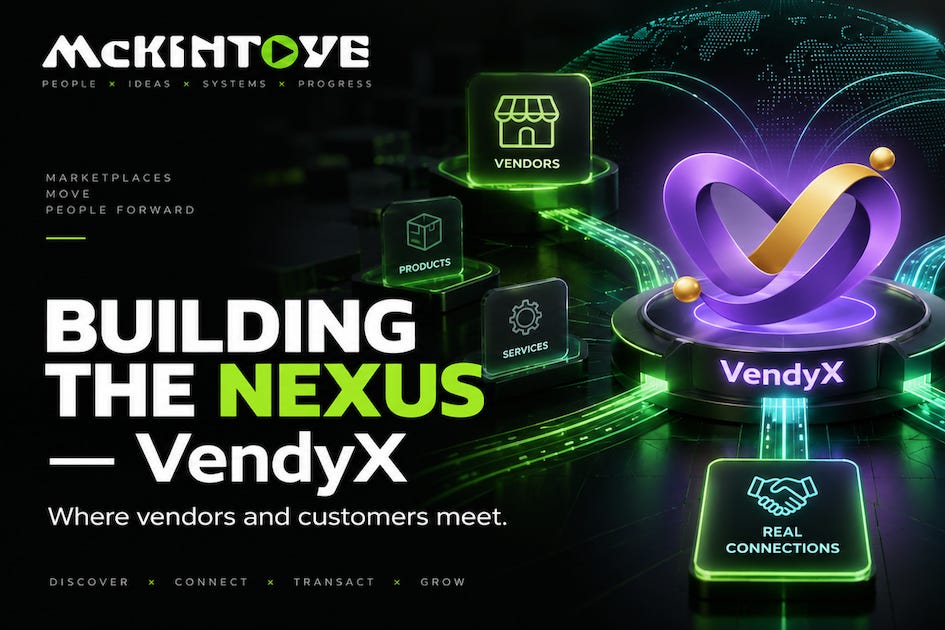
Instead of asking how to build something around one type of vendor, I became more interested in the point where vendors and customers meet.
Not simply a directory. Not simply another place to put a business name, phone number, and photograph. I was imagining a connection that could work in both directions. That idea became VendyX.
A customer looking for a photographer should be able to find one. But a customer should also be able to say, in effect, Here is what I need, and create an opportunity for the right vendors to respond.
A vendor should be able to show what they do without depending entirely on who already knows them. That was the idea beginning to take shape. But an idea is not a product.
VendyX would eventually need a name, designers, developers, product thinking, research, operations, and people willing to challenge what we thought we were building.
Some versions would work, and some wouldn’t. We’d spend money, learn lessons, and have conversations with vendors that would change how we understood the problem.
The idea would change. The team around it would grow. Our understanding of the problem would grow too. But underneath everything that came afterward was a fairly simple thought from someone standing behind a camera—a thought that helped shape VendyX:
I wanted to be hired for my work.
And I started wondering how many other people felt the same.


